Saturday, November 04, 2006

Biometrics


Ideas are bit like buses, you wait for ages then three come along at once. One idea that has been around for quite a while is computer odor recognition. This week I saw a computer being used to transmit a smell using a PC. You click on an image of a flower or whatever, and the smell is transmitted.
My first thought - naturally - is how could that be used in animation? One idea would be to link it to animated Greeting cards for birthdays, Christmas, and the like.

My second thought is how could it be abused by hackers. Well, they could spam you with nasty smells I suppose, but smells might also be the ultimate password. Check
http://ezinearticles.com/?Biometrics---Customer-Friendly-Computer-Security&id=106788

Another problem is that smells aren't easy to pin down. You can say something smells like a rose, but what does a meadow smell like after the rain? You need an image of a meadow, and sorting images out has been another problem waiting to be solved, and perhaps it now has; or so they say at
http://www.cbc.ca/technology/story/2006/11/02/tech-imagetag-061101.html

The Gadget Show is the show to see for all those gadgets that you cannot imagine anyone buying. This week an inflatable church big enough to hold sixty people (could be a cinema), and yet another attempt to make a 360 degree cinema screen so that you feel you are in the centre of the action.
Of course, Multi-screens have been around for very many years, but the main problem is having projectors both small enough to fit into the cinema, and synchronising them. Both problems now easily solvable; it only requires suitable stories to make use of them now.

Stan

Tuesday, October 31, 2006

Input Output


When I started in Computer Animation in the mid 1960s, Input devices were limited to a teletext type keyboard, a lightpen (if you had a screen, and most didn't) and a Puck; a sort of pre-history mouse. Your output was punched cards, and later punched tape. On one ocassion around 1970 I was on a TV programme about computers; I held up a piece of punched tape and said "One day film will look like this".


Things have moved on, and Input devices come in many forms; a very interesting one that looks to change the world can be seen at
The "interface-free," touch-driven computer screen, which can be manipulated intuitively with the fingertips, and responds to varying levels of pressure.


Output devices are no slowcoaches either. The largest digital photo has recently been shown, coming in at around 35x32 feet and 8.5 gigapixels. True it's not a moving picture, but a week or two might change that. You can see it at http://slashdot.org/article.pl?sid=06/10/29/2239224


Using the brain as an input device has always been the realm of Science fiction, but getting increasing attention in recent years. Biofeedback was quite popular in the 1960s, but lacked the technology to do anything serious.


One aspect of recording brain patterns I find interesting is not as a computer input device but as a lie-detector. As a writer 'telling lies' is something inherent in many stories; Crime and Love obviously, polititicians, car salesmen, lawyers, and Estate agents might consider the ability to lie as an asset. Doctors may have to do it to be kind, A TV programme on 'Honesty' said that Society would break down if everyone was honest!


Another interesting article came out today about a competition I'd never heard of called the Hutter Prize http://science.slashdot.org/article.pl?sid=06/10/29/2127201
It is about compressing data, and presumes that compressing data in files is similar to how the brain works.

There are some people who believe that the brain is a bit like a cupboard, and that you can only put so much into it. Others (and I am one) believe that the brain can hold an unlimited amount of information. The reason animation works so well as a teaching aid is that it eliminates all but the essential material of the subject it is presenting.
The fact that people with phenomenal memories say they recall numbers as pictures indicates that we might have been using our brains in the wrong way for a few thousand years.
Need I say that teaching animation as a core subject in the curriculum will change all that?
Stan

Monday, October 30, 2006

Drawing in the air


It's Fireworks day next week; as a child I used to wave sparklers in the air to create patterns. At best I could get circles, and perhaps figures-of-eight, but not pictures, though I have seen simple pictures created in the air by lasers.

Of course, if you could move the laser fast enough you might create a whole picture. It works by persistance of vision, but that only lasts for a fraction of a second.

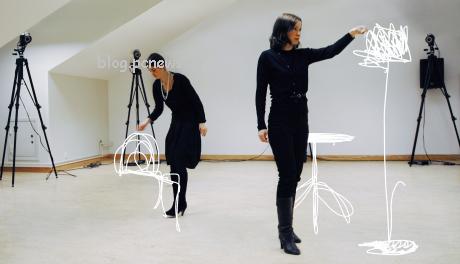
Supposing you could draw slowly and still see your picture? Well, that's what some clever people have done. Not only can you draw slowly in the air, you can do it in 3D, and have the object you drew actually created. Don't believe me? then go to http://blog.pcnews.ro/2006/10/28/sketch-your-furniture-in-the-air/
Apart from drawing in the air, you can also project images onto air. Take at look at http://blog.pcnews.ro/2006/07/27/real-display-like-in-star-wars-movie/

Miracles are getting commonplace now in the world of animation, so we need a new word to cover things that can only be done by divine intervention. But even the divinity is getting mapped out by animation. Look at http://www.secondlifeinsider.com/category/educational/ a 3D weather map. Scientists have just launched a satellite to map a 3D picture of the Sun as well.

Not many of us have a need for 3D images of the Sun, but how about having your own avatar that can try on clothes for you? If you're interested look at http://www.secondlifeinsider.com/category/clothing/

The scariest aspect of 3D mapping I've seen was on a Horizon show last week where they showed experiments for mapping the brain. Different areas of the brain are highlighted as you think about different things. They say that one day they will be able to replay the images from your brain so you relive the experience, even to the point of capturing dreams!!!

I'd have second thoughts on that one, and just hope that the second thoughts don't get mapped.


Stan

Saturday, October 28, 2006

Save the World


Hardly had the ink dried on my laser printer from yesterdays post about computers recognising movement when I came across and article about a computer that does just that. Check it out at http://www.newscientisttech.com/article/dn10387-surveillance-system-spots-violent-behaviour.html
It seems it can distinguish between friendly and hostile behaviour. Put one of these on a robot and let it roam the streets and we will live in a peaceful, though somewhat inhibited society.

Of course, the world has other problems apart from our trying to destroy each other. In our spare time we also try to destroy the world; but not any more, the people at GlobalSchoolNet are looking for ideas to prevent global warming. You can find their site at http://www.google.com/educators/globalwarming.html
The idea is to get children and young people around the world to submit ideas and work together collaborating on movies and projects to get it sorted.

Once crime and global warming have been solved there are quite a few other problems to keep us busy. You can find some of them at Save the World

Stan

Friday, October 27, 2006

Silent voices


Have you ever had to get your movies translated into another language? Subtitles are not great because you miss the action while reading them. Dubbing is not all that good as it is usually obvious that the lips are not in sync with the sound. In live-action the background actors can sometimes get by saying 'Rhubarb, rhubarb' and making suitable gestures, but it's a problem yet to be solved.


As I am severely deaf, I have learnt to lip read to a limited extent. I never took lessons, but often watch TV with the sound off. It works OK with news readers but not so well with actors; so I am always interested in new ideas related to hearing.

One idea I read about yesterday at http://www.newscientisttech.com/article/mg19225755.800-its-the-next-best-thing-to-a-babel-fish.html describes a method whereby the speaker simply mouths the sounds in one language and it gets instantly translated into another language.


The method is not yet perfect, but the potential for the Movies is fantastic. As it depends on facial movements instead of sound, then an actor could be connected to many machines and do translations into dozens of languages at once. A step further would be to record the facial movements for a given actor and apply these to an avatar. For the technically minded you can look at http://www.mcrlab.uottawa.ca/papers/ACM-postr3.pdf dealing with Virtual Reality.

What will they think of next? Well, if you want to find out then take a look at Lip shapes .
If you just want to amuse yourself then try http://www.dookyweb.com/avatars.swf

Stan

Thursday, October 26, 2006

Face Recognition


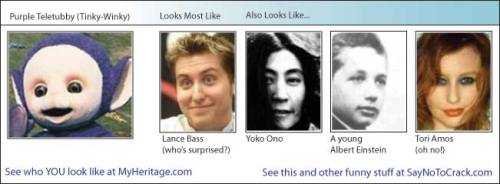
An interesting article in the nerdy news today about computer face-recognition. Look on www.MyHeritage.com for details, and on http://www.saynotocrack.com/index.php/2006/10/23/celebrity-look-a-likes-part-i/ for the article.
Put up a photo of your face and it will compare it to a list of celebrities to see who you look like. Someone tried it with some 3D animated characters. This is one with the teletubby who seems to come off well by comparison.

The system works by comparing the face with a list of celebrities who have already been digitised. I tried the program using 2D characters but it doesn't work, but if it did, it seems to be a good way to find those elusive cartoon characters who you can't remember the name for.

I wonder if the system might be extended to check movements such as walk-cycles. If it could then it might be able to guess someones age, gender, height, weight, etc reasonably well by the way they move. That could be useful in looking for people in a crowd, a bit like spotting car numbers as they move. A step in that direction has already been made, which you can check out at http://www.3g.co.uk/PR/Jan2005/8955.htm.

Stan

Wednesday, October 25, 2006

Virtual fantasy


Today I came across a news item at http://infolab.northwestern.edu/project.asp?id=40 . It is about news casting with computer generated characters.

Aparantly news items gathered by search engines are transcribed from written text to spoken text - as against simply reading the written text; Clever!!!

Even as I was reading the article it ocurred to me that it would be nice to scan in a novel and have it instantly turned into a movie.
But that is an obvious application. It would be pretty useful to have technical data spoken to you on how to operate your washing machine, or what your mortgage contract is actually saying.

Only last week I read of a handheld computer used by troops in Iraq that can do instant translations, so put them together and you could talk to anyone around the world using a nice looking version of yourself. It seems to me something that could put the Generals out of work.

I have always felt that animation can save the world, and it is certainly making inroads into crime. A recent article stated that video tapes of criminals caught on CCTV are now having their walks analysed by computers. We all have a walk cycle as unique as our fingerprints so it seems a good idea.

What else can be done? As CCTV cameras don't have sound they can't capture voiceprints, but that can't be too difficult to do.
A couple of years ago we ran a workshop called 'Kids Crack Crime' getting young teenagers to suggest ways of catching criminals, and making a short cartoon of it. The project went well, the group we worked with won the Guy Ritchie Award.

I look forward to 'Crime Watch' being shown with Computer generated presenters, with the crimes being re-enacted by avatars. We might soon be calling Reality 'Virtual Fantasy'.

Stan