Tuesday, October 17, 2006
Computer Games

Sunday, October 15, 2006
Animation Data Banks

When I started in Animation around 1958 life was simple in the Animation World. Animation fell into just a few categories of drawn, cutout, and model/puppet -which covered just about anything in 3D. There were some experimental techniques, but generally speaking you could see how any technique worked just by looking at it. Apart from the techniques, anyone from cameraman to editor could go to any studio in the world and all the equipment would be more or less the same.
Not so today; in fact two animators doing exactly the same type of work might well be using entirely different computer programs to do it, and the time taken to learn such programs would often mean they are stuck with their choice of program. As many programs come and go, it is worth spending time finding out what is likely to be around for the future.
As I am constantly looking for trends in animation I spend much time checking out links to the various animation categories. It can be quite frustrating at times, so I was pleased to come across the site at http://www.visualcomplexity.com/ which shows how Computer Animation can help out with visual search engines. The top image is an example of a visual data bank.
As far as I know, none have been applied to the 'World of Animation', but the potential is there, and if anyone gets around to doing it, much time and effort will be saved.
There are - of course - some good specialised Animation data banks. One of the best is:
http://www.awn.com/ and a subsection at http://schools.awn.com/
The big problem is that search engines have difficulty in searching for specific images. If you want a particular Bugs Bunny movie you can check out Chuck Jones, but the vast majority of animated movies don't get listed in a way that is easy to categorise. Until they do the best that can be offered is Animation Database and Animation Databanks
Stan
Saturday, October 14, 2006
Instant Animation

In a few days I'll be 76. Someone asked me if I lived my life over again what would I do that I hadn't done. The answer was easy; I would save the world.
Of course Superman - who is roughly my age - wanted to do the same thing, but his approach is to take out all the bad guys, whereas my approach would be to teach everyone animation which, as a universal language, would help the bad guys and good guys get along better.
Teaching everyone to animate is not an easy task, but it will become easier with a program a friend directed me to yesterday at:
http://www.youtube.com/watch?v=df8wAla57PI
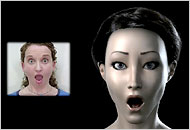
This is one of a new breed of programs like K-sketch which enables users to animate without having to learn animation. You can also use libraries of free animations such as: http://gifanimations.com/ and http://www.animationlibrary.com/
The idea of using art to unite the world is not entirely new either. UNESCO runs a number of programmes at Digiarts.
Some other sites can be found at Kids Art and Freebies
Stan
Thursday, October 12, 2006
Sound Effects

Instead of trying to teach animation I started with the idea of making a soundtrack for a haunted house. I asked them if they could scream, groan, and work out some grisley sounds; they could and did, and loved it.
We never actually got around to making a movie for the track to go on, but did quite a bit of other noisy recordings, and in the process released a lot of pentup tension in the group.
With young children it's a good idea to start with animal sounds. You can find many sites with these, but a good one is http://www.davisfarmland.com/fun/funsound.htm
Of course, all children can make animal sounds, but it is interesting to know what sound they make.
Trying typing in Animal sounds + Africa and then change the country.
Another site at http://www.findsounds.com/types.html has a huge library covering just about anything you can think of. Acting out movements with the sound effects is good fun.
It is a good excercise to try and create your own sound effects with your voice, and things you can find in the class room. Shake, rattle, and roll things around; tap, drop, and scrape things. Then suggest how one can make sounds like the wind and rain.
Here are some other sites to get started on:
Wednesday, October 11, 2006
Children's Art Therapy

Tuesday, October 10, 2006
scribbling

I once worked with Special Needs children, and had a 14 year old boy who was brain damaged He had a mentality of a 3yr old, and his teacher dismissed him as unteachable, but I included him in the animation class.
I gave him a pile of paper and coloured crayons, and then asked him to scribble. The end result was a pile of scribbled paper in different colours which I shot as a sequence so they animated. He was delighted, and wanted to do more. Unfortunately I was not able to work with him again, but there is no doubt in my mind that scribbling would have helped him in some way.
Very young children will often scribble a meaningless mess, and when asked what it is, say Mummy, or Rover, or whatever comes to their mind. It is a big conceptual jump for children to associate a mark with person or object.
Another interesting site is at http://www.bartelart.com/arted/wallscribblers.html which deals with the therapeutic aspect of scribbling.
Not being an animator but needing to draw storyboards, I learnt to do quick sketches by scribbling on scrap paper very quickly to get the feel of the pencil. It's a bit like practising your scales until you can do it without thinking.
I've read somewhere that if you are right-handed, then scribbling or writing with your left hand will develope parts of the brain that other excercises haven't reached.
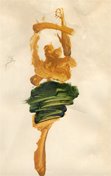
The drawing at the top was done by my daughter when she was three. She said it was 'A squirrel in its house at the top of a tree'.
On speaking to a teacher about dyslexia, she told me that it is common among criminals, and I am aware of it being common among truants as I've worked with children who have been dismissed from school for truancy.
Typically they were not able to keep up with other children when it came to reading and writing, and were not offered alternative ways to express themselves. Something as simple as scribbling might well offer one contribution to the problem.
Checkout: Scribbling
Stan
Sunday, October 08, 2006
Optical Toys
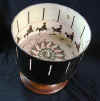
The easiest introduction to movie making for children is to use Optical toys. I normally start with rollers and flip books then move on to Zoetropes and Thaumatropes. The main thing with children is keeping them busy with projects they can do quickly and get results.If you are not familiar with Optical Toys then good starting places are:
http://courses.ncssm.edu/GALLERY/collections/toys/opticaltoys.htm
and
http://www.precinemahistory.net/900.htm
A recent discovery of some mechanical parts from an unknown Ancient Greek machine has suggested they had some form of mechanical calculator. I have often wondered if they also started animation.
I have never seen any reference to it but Greek vases with figures on them in stages of a walk cycle animate perfectly; and movies have been made of this.
Bearing in mind that these vases are made on a potters wheel, it would not take much imagination to have a 'gate' operated by the wheel so that you saw the figure animate as with a Zoetrope.
One of the problems I had in running workshops in schools is that the Head Teachers would often wonder where 'Animation' fitted in. Some think of it as Art; some as Computer training, and some used it as 'end of week' leisure activity.
It is this 'identity problem' that is perhaps the biggest barrier to getting animation into schools as a core subject; Optical toys are a foot in the door.
Look at Optical Toys
Stan