Monday, November 13, 2006

Is there a Doctor in the house?


I have a friend whose parents run a pharmacy. She tells me that they advise her not to take pills, creams, tablets etc. What good advice! as we all have medicine cabinets full of such stuff tried a few times and found either not to work, or we get better before it has any effect.

That is not to say that trying to cure oneself is a bad thing, but just that we often don't know what is wrong with us in the first place, and the pharmacist will helpfully sell us anything. My guess is that the drugs industry grows rich on what we throw away.
You will be happy to know that our doctors often don't know much more than we do; but that is about to change as they are now turning to Google to get their diagnosis sorted out, as you can see at http://www.dailymail.co.uk/pages/live/articles/health/healthmain.html?in_article_id=415641&in_page_id=1774

I have been using Google for years to do this, and proud to say I have survived lots of illnesses I would not have known I had if it hadn't been for the information on the various websites dealing with medical self-help.

What has this got to do with 'Animation'?, well, many of those sites use animation to show how the body works. You can find quite a few good examples at: Diagnosis and with a good site at http://www.animatedhealth.com/?gclid=CPG3ocrFw4gCFRRZMAod4BsWDA

I have feeling that if this catches on Medical School will be little more than a computer and some holographic cadavers. It may well cut down on Medical costs and improve treatments, but what will happen to all those Hospital based TV Soaps?

Stan

Sunday, November 12, 2006

Future Shock


How would you like to see what the future holds for you? Well you can - in a sort of way that is. A program with the springtime name of APRIL lets you see what you might look like at some distant time; the Christmas of your life.

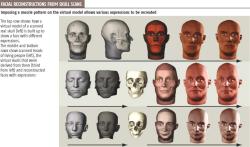
Forensic animation has been used for a while to help visualise missing people and see what they might look like after some years. It's also used to see what dead people might have looked like alive. A gruesome subject but one that will play an increasingly useful role in changing our behaviour if the health authorities have their way.

The above program can indicate what you will look like in a few years if you choose a decadent life style. I recently saw examples of it on TV when certain celebrities who punish their bodies in various ways from drug taking to excessive fitness regimes were shown as they are now, and how they will be in twenty years time. I can image a sneering image of ones aged self staring back from the screen and saying "Look what you've done to me you idiot".

The program would have obvious uses in the Movie world to show how actors might age in a role. It might also have a slightly more sinister use if we secretly checked out how our partners might look in the future.
I know that similar programs have been used to morph the faces of parents to show what their unborn child might look like, but have never seen whether this actually works.

Of course this does put an emphasis on beauty, and we intuitively feel that two beautiful parents will produce a beautiful child, but apparantly not, though 'beautiful' parents do tend to have 36% more chance of having a girl child. I'm not sure what it all means, but animators looking for new directions in the industry might check out beauty salons or mortuaries for vacancies.
Stan

Friday, November 10, 2006

Being Funny


I understand that Science has seven big fundamental questions of the order 'How did Life start'. I can't remember what the other six are, but one of them must surely be 'Why are some people funny and others not'. I am happy to say that Science has now solved this problem, with the little help from its animation friends and a morphing program.

"The characteristics of a feminine face imply that the person may be agreeable and co-operative, which can be causal in our first impressions of comedians as being friendly and funny."
Dr Little used computer software to blend together 179 different facial aspects of 20 top comedians, resulting in the "perfect comedy face".
And picked Ricky Gervais as having the perfect comedy face - so that proves it.
I would like to see the system applied to Politicians, and a few others who we might put our trust in.
A recent study regarding 'Prejudices and what we look like' can be found at http://www.badscience.net/?p=219. It supports the obvious in that we are attracted to beautiful people, but that is partly because - as those of us in the movie business know - the good are beautiful and the bad are ugly. Disney made a mint out of it; and anyone working in the Animation industry is aware that a Cartoon's face is its fortune.
The constant reinforcement of what is Good and Bad stemming from the worlds of advertising, movies, and fashion may be conditioning our brains in a way that Religion did in history.
If computer games are making children violent then animation has a lot to answer for. On the other hand, if animation can define the 'Perfect Comedy Face' then perhaps there is a 'Perfect Tragedy Face', or a perfect face for any attribute you can think of.
It would certainly be handy for checking passport photos, Internet dating photos, and personal photos for our CV, but I can see the possibility of plastic surgery opening up new fields of expertise with body parts as yet unexplored.
Stan

Man bites God


A few posts ago I mentioned advances in movie projectors and referred to projecting onto clouds. One reader - Deborah Kelly - sent me an image of her work doing just that(http://www.bewareofthegod.com/?cat=9).
But what was of more interest was her work as an Activist-Artist.
Having 'Beware of the God' projected in Heaven seems a good way of getting the message across, bearing mind the recent trouble with the Prophet Mohammed cartoons published in Denmark. No one questions the power of Political cartoons; apart from their instant summing up of a situation, they are globally recognised. It is a power that has yet to reach its full potential.
The 'Hitchhikers Guide to the Galaxy' made the ultimate blasphemy of having God as a Super-computer - it is a belief that gains adherents daily - so it was interesting to note that scientists who build such machines are turning to animation for the next divine upgrade.
It seems that the chips that power computer games are currently the most powerful ones around, and will be the basis for the next Supercomputers, but they will not be for playing games, only rather boring things like curing diseases so the world become over-populated, and designing bombs to cure the problem.
As we all know, there is only one problem in the world - other people - and computer games at least allow us to live in virtual worlds where other people either live by our personal standards or get zapped for not trying. Someone - whose name escapes me for the moment - said "All the Worlds a stage". My guess is that it's a computer game, or soon will be.
Stan

Thursday, November 09, 2006

Interesting


How do you measure how interesting something is? Well one way is feedback. If someone has a Blog that gets 10K hits a day then you might guess it is more interesting than one that gets 5K hits daily. But that is a measure of quantity rather than quality, so is a statistic rather than a 'value'.

I mention this because Flickr has just taken out a patent on 'Interestingness' for searching images. I don't know how it is done, but the idea itself is interesting. If my computer recognises that I spend much time looking up trends in Animation it might guess (in its own computer way) that I find 'Animation' interesting and be able to assess my taste in this field. I would guess the system might have more applications in computer dating though.

I sometimes add little animations to my posts to friends; typically small Gifs of something relevant to the message. It ocurrs to me that these might be used as 'Digital signatures' or 'Watermarks' to assure my friends that they come from me.

Such animations might also be used as a Password. I'm guessing it would be easy to do, and make it more difficult for hackers to get to your passwords. My thoughts on this were prompted by an article about 'captchas' which describes how images instead of words are now being used to try and fool hackers.
Of course, it is well known that most of us use passwords relating to something that is of interest to us. Using a picture or animation of something that is of interest to us would certainly raise the bar for hackers. Perhaps Flickr knows something that we don't.

Stan

Wednesday, November 08, 2006

Now you see it, now you don't


Back in the 1950s some experiments were done on using movies as anaesthetics with some success, but as far as I know this method was never used in hospitals.

While working at the Canadian Film Board in the early 1960s I met Norman McClaren, the experimental film maker, and asked if he thought films could be used in this way. I got a record on self-hypnosis, and he had some experimental films with concentric circles gradually shrinking. We put them together and showed the result. It made many people seasick!!!

I never pursued that line again, but later worked in advertising when Subliminal Advertising was tested. It was so successful that it was banned, or supposedly so, but one doesn't know if it actually was, but 'Placement Advertising' is perfectly legal, so in effect the method is still being used.

I have used it in animation as a Special Effect. If you want to create a disturbing image you can colour it with two very close colours and let them flicker. It is not visibly noticeable but mentally upsetting.
These ideas came to mind recently when reading about Spam mail. It seems one way to fool Spam filters is to have the background colour actually several very close colours.
You can write white text on a very slightly off-white background and mentally take it in without actually seeing it; a hi-tec invisible ink. And text can easily be implanted into an image. This is a common encryption method.

Forgetting Conspiracy Theories of us all being brainwashed, could such methods be used as anaesthetics? Could it be a way to control crowds with flashing lights? Could it be used in education? Whatever, there is no doubt that Animation has come a long way from funny cartoons.

Stan

Tuesday, November 07, 2006

Writing for animation


By chance today I see that Microsoft has just taken out a patent on software to help "children write stories". I wondered if Microsoft are trying to put me out of business! But on checking their patent, it seems to be related to manipulating images- so that's OK.

The easiest way to get children to start writing is to let them write 'All About Me', covering what their favourite food, sport, lessons, etc, are, and what they dislike most. Of course, Social Networking and Blogs are just that in a more elaborate form.

Writing about oneself is a great therapy - as is talking about oneself. And part of that therapy is due to the fact that someone is actually interested in us. But of course, not everyone who is interested in us has the same motives.
There are lots of online questionnaires asking us details of our buying habits and social activities so they can draw up a 'Profile' for marketing; that's innocent enough, and we all know what it is about.
But supposing these marketing profiles and our networking/blog profiles were matched up, it would give a fairly accurate picture of who we are and what we look like. Well, the 'Big Brother' idea has been done to death, but I'm thinking in terms of creating characters for stories.

Would it ever be possible to feed a computer a profile of someone based on their Blog/Network profile, and buying habits, and get a reasonably accurate image of the person?
I for one, wouldn't say it couldn't be done. I shall be keeping a beady eye out for more Microsoft patents.